

How Much RAM Do Gamers Need? 8GB vs. 16GB vs. 32GB
Today nosotros're looking into how much RAM you need to play the latest and greatest gaming titles released this twelvemonth. About this time each year we gear up on a memory capacity quest and last year's expedition lead us to conclude that for gamers 4GB is out, 8GB was the bare minimum, 16GB is the sugariness spot and 32GB is overkill. With that, for the 2022 version we're dropping the 4GB configuration and focusing on 8, sixteen and 32GB capacities.
As the championship suggests the emphasis is on gaming. For general computing, it will actually depend on the applications and even and then, what you're doing with said application. Premiere Pro using 4K footage eats a lot of RAM, and this is where having 64GB or more than will get you tangible benefits. So it's best to research the requirements for the detail applications and workloads yous intend on using.
When it comes to game testing, properly measuring the impact of RAM capacity is no easy task every bit at that place are many factors at play. We like to briefly talk over some of things for amend understanding of our methodology and the challenges faced when testing system memory. Challenge #1: picking the right hardware. The graphics card you use can influence how much retention yous'll need for smooth gameplay, and in worst case scenarios the speed of your storage can too impact performance.
For case, last twelvemonth nosotros institute using the GTX 1060 3GB would often result in college organization memory usage compared to the 6GB model. This is because at times you lot'll run out of VRAM, forcing the operating system to tap into system memory. If you run out of arrangement memory, some game avails are moved to your local storage device, though at this point the performance hit will be so meaning that the game will near certainly become unplayable.
In other words, testing with an RTX 2080 Ti and its 11GB VRAM buffer along with a super snappy NVMe SSD, probably isn't the best way to decide how much organization memory the boilerplate gamer requires. We'd likewise assume if you have a $1,000+ graphics card on your arrangement, buying xvi GB of RAM or more is not an issue. Although even then, the analysis is part of the fun here.
But there are withal more factors to consider. The quality settings used on games can likewise have a big impact. For example, if you utilise a GTX 1060 3GB and are happy turning textures down to a medium quality setting, then that volition reduce how much information is offloaded to the system memory.

Taking all this into account, we've tested a number of dissimilar hardware configurations and we'll be showing the impact this has on functioning. Also, during our testing final year nosotros discovered some other issue with trying to prove the fps difference betwixt the diverse hardware configurations. Typically our benchmark passes run for 60 seconds and are run multiple times, then report a 3-run average. This means the system has a chance to enshroud the pass. So while the results from the first run might see a shockingly low 0.1% or 1% frame time figure, this tin can exist improved dramatically on the second run, so again on the third. So displaying the three run average can be misleading.
The best solution for this was to run each benchmark once, and then reset the entire organization, load the game from zilch and run the adjacent laissez passer. The criterion pass is actually 90 seconds in total but I merely report the frame rates for the last 60 seconds. This mimics more what y'all'd meet when playing the game, for the initial 5-10 seconds the game tin still be loading assets as you play, and this tin can cause frame drops, even on computers with sufficient system memory.
Finally, benchmarks aside, a good indicator for working out how much memory you lot'll need to play the latest games is to just monitor memory allocation. It'south not foolproof simply it gives us a pretty good idea of how much organisation retention a game requires to avert any slowdowns.
Taking a Look at Memory Allotment
With that explanation out of our way, we're start going to testify yous retention allocation in a few popular titles. All these gameplay tests were conducted with a Core i9-9900K, 32GB of DDR4-3400 memory and a GeForce GTX 2080 Ti. The exam system has a number of applications running in the background such equally Steam, Origin, Uplay, Boxing Net, Epic Games Launcher, Discord, Chrome with a few tabs open up, MSI AfterBurner, RivaTuner and Fraps.
We should also notation that all testing has been conducted at 4K using the highest possible quality preset with the RTX 2080 Ti.
Starting with Assassin's Creed Odyssey, we run across around 29% of the 32GB allocated. Throughout our testing in this title RAM usage hovered between nine.three - 9.5 GB with VRAM usage at around 8.1 - eight.2 GB. This suggests that systems with just 8GB of RAM could see some performance issues related to organization retentiveness.

Next we tested Battlefield Five multiplayer using the 64-histrion mode. Here RAM usage got up to around 33% hit 10.8GB and basically never dropped below x.4GB. VRAM allotment was also very loftier, holding steady at 9.7GB on the Narvik map. So we have another championship that will likely encounter stuttering bug with 8GB of memory.

Call of Duty Blackness Ops iv turns out is a serious memory pig. At least based on the small corporeality of testing we've done, RAM allocation held steady at 12GB, while VRAM usage was high at ~10.5GB making this the most retentivity demanding title tested yet.

F1 2022 is a title that yous'll go away using 8GB of memory as nosotros saw system memory usage peak at 8.5 GB. It's right on the edge but yous'll probably get abroad with that. At 4K VRAM usage was striking 7.5 GB just any GPU that can handle this resolution will take at least 8GB of VRAM anyway.

On Far Cry 5 nosotros saw RAM usage hit ix.8GB, though VRAM was reasonably low at 5.8GB. At about 10GB of system memory y'all're starting to become a chip far across what 8GB of organisation memory volition let you get away with.

Hitman 2 pushed total arrangement memory allocation over 10GB for the entirety of our test and peaked at around 10.3GB. VRAM usage was similar to what we saw in Far Cry five at around five.6GB.

Just Cause 4 was very light on retention though Barrage's Apex game engine is seriously showing its historic period in 2022. Less than seven GB of RAM was allocated in total and less than 5 GB of VRAM was consumed.

Monster Hunter World is a title that should work just fine with 8GB of RAM, hither we saw allocation superlative at viii.iii GB. VRAM usage was likewise low at under 5GB.

Shadow of the Tomb Raider is certainly ane of the all-time looking games released this twelvemonth and while information technology uses a reasonable amount of arrangement memory, information technology'south certainly not farthermost at around ix GB. VRAM usage was comparably higher over 8GB consistently.

Star Wars Battlefront Two is a memory intensive title as we saw RAM allocation pushed to ~10.5GB. VRAM usage was also quite high at around eight.3GB.

Foreign Brigade is a well optimised title that runs very well on a broad range of hardware. Therefore it wasn't surprising to find that the retentiveness requirements aren't high. seven.5GB of RAM was allocated though at the 4K resolution VRAM usage did hit 6.5GB, certainly naught extreme there.

Last in line nosotros accept Vermintide 2 which consumed near 9GB of RAM, while VRAM usage was relatively low at v.v GB. This is probably a title you could play with viii GB of RAM merely you would be correct on the edge.

That's our look at memory resource allotment using high-finish hardware in a dozen titles released this twelvemonth. Permit's now have a closer await at the performance numbers when testing with Battlefield V, Hitman ii and Shadow of the Tomb Raider.
Benchmarks
We've split this in ii parts: starting time with loftier-finish GPUs at 1440p and 4K, and then with mid-range GPUs at 1080p and 1440p. For this part of the testing we're using a Core i9-9900K and the only hardware modify other than the graphics card is obviously the retention.
Nosotros're using Team's T-Force Dark: for the 8GB configuration we take a kit with 2 4GB sticks using CL15 timings. Then basically the same kit but with 8GB sticks for a 16GB capacity. For the 32GB testing nosotros're populating four slots with 8GB sticks. Squad Group does offer a 32GB kit with two 16GB modules, just they use looser timings so nosotros opted against using that memory.

Using a RTX 2080 Ti, Vega 64 Liquid and GTX 1070, we see most no departure in operation between the 16GB and 32GB configurations on Battleground Five at 1440p. Given what we merely saw when looking at the on-screen statistics this shouldn't surprise anyone.
However, when we reduce memory to 8GB we start to see a reduction in performance when looking at frame time performance. The boilerplate frame rates encounter no more than a ii fps change, but if we look at the 1% low and in particular the 0.1% low results, nosotros meet that frame rates accept get less consistent.
For the RTX 2080 Ti we meet up to a 7% drop in frame fourth dimension performance, 8% for Vega 64 and 7% for the GTX 1070.

Moving to 4K, the RTX 2080 Ti'southward frame time result suffers by 5%, but more than interestingly there is some reduction when going from 32GB to 16GB which was unexpected. Furthermore, the 0.1% low issue is reduced past 10% when going from 32GB down to 8GB. Yet, for the more heavily GPU spring configurations using Vega 64 and the GTX 1070 we see that the deviation in RAM has footling bear on even at 4K.
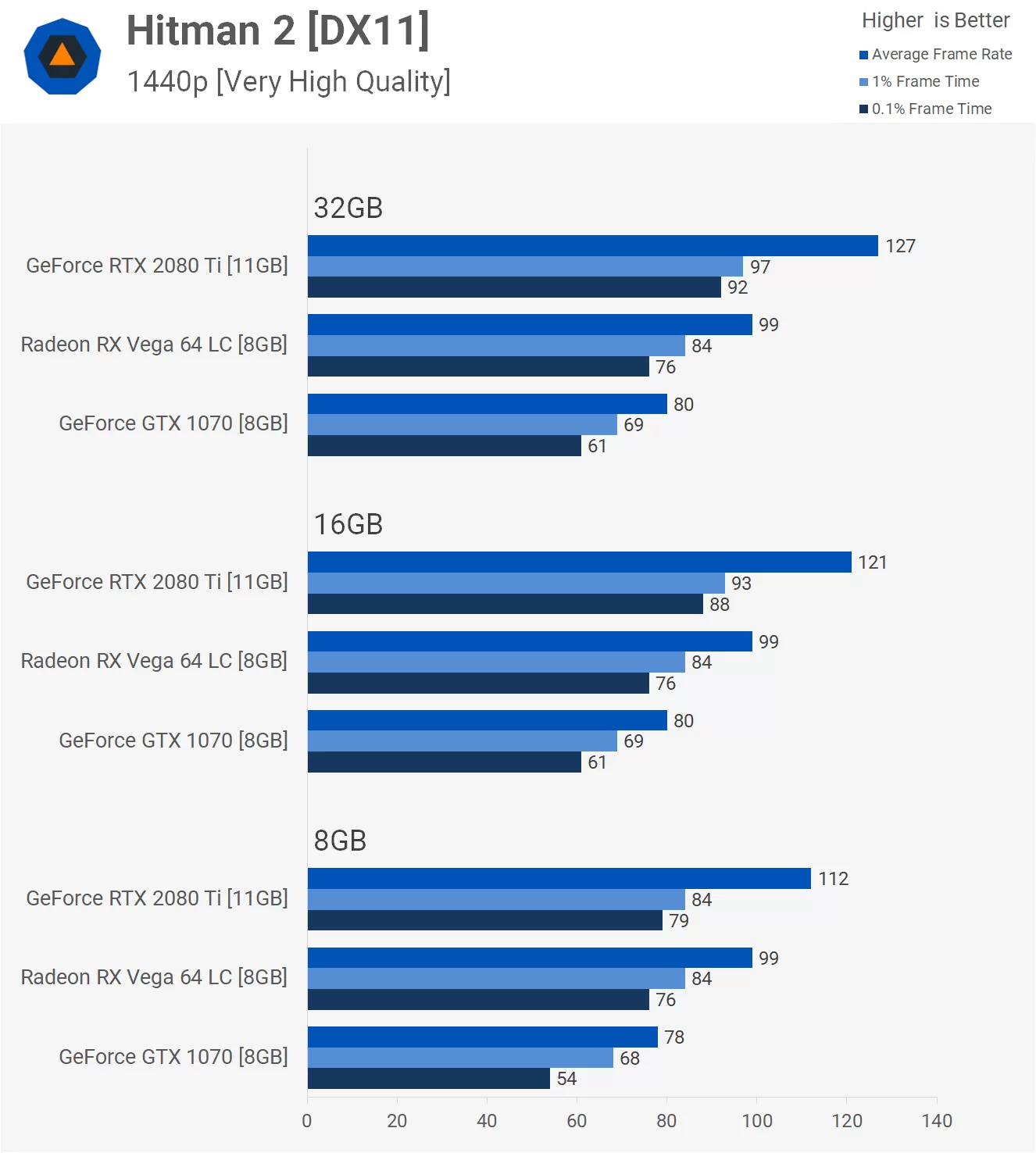
The Hitman 2 results are interesting for a few reasons. The RTX 2080 Ti consistently saw a performance reduction as we lowered the amount of available arrangement retentivity, and it wasn't merely frame time performance that suffered. We saw previously that this game was retentiveness hungry, but 16GB of RAM should more than embrace it, then information technology's interesting to run into the 32GB configuration offer 4-5% more performance.
This performance proceeds with the 32GB configuration wasn't seen with either Vega 64 or the GTX 1070.
Vega 64 delivered the same performance beyond the board, while the GTX 1070 saw the same functioning with 16 and 32GB, and frame time functioning starts to suffer with 8GB. Here nosotros saw an eleven% driblet off for the 0.one% depression operation.

Moving to 4K, nosotros see ameliorate functioning for the RTX 2080 Ti when paired with 32 GB RAM over again, with frame time performance boosted by as much as vii%.
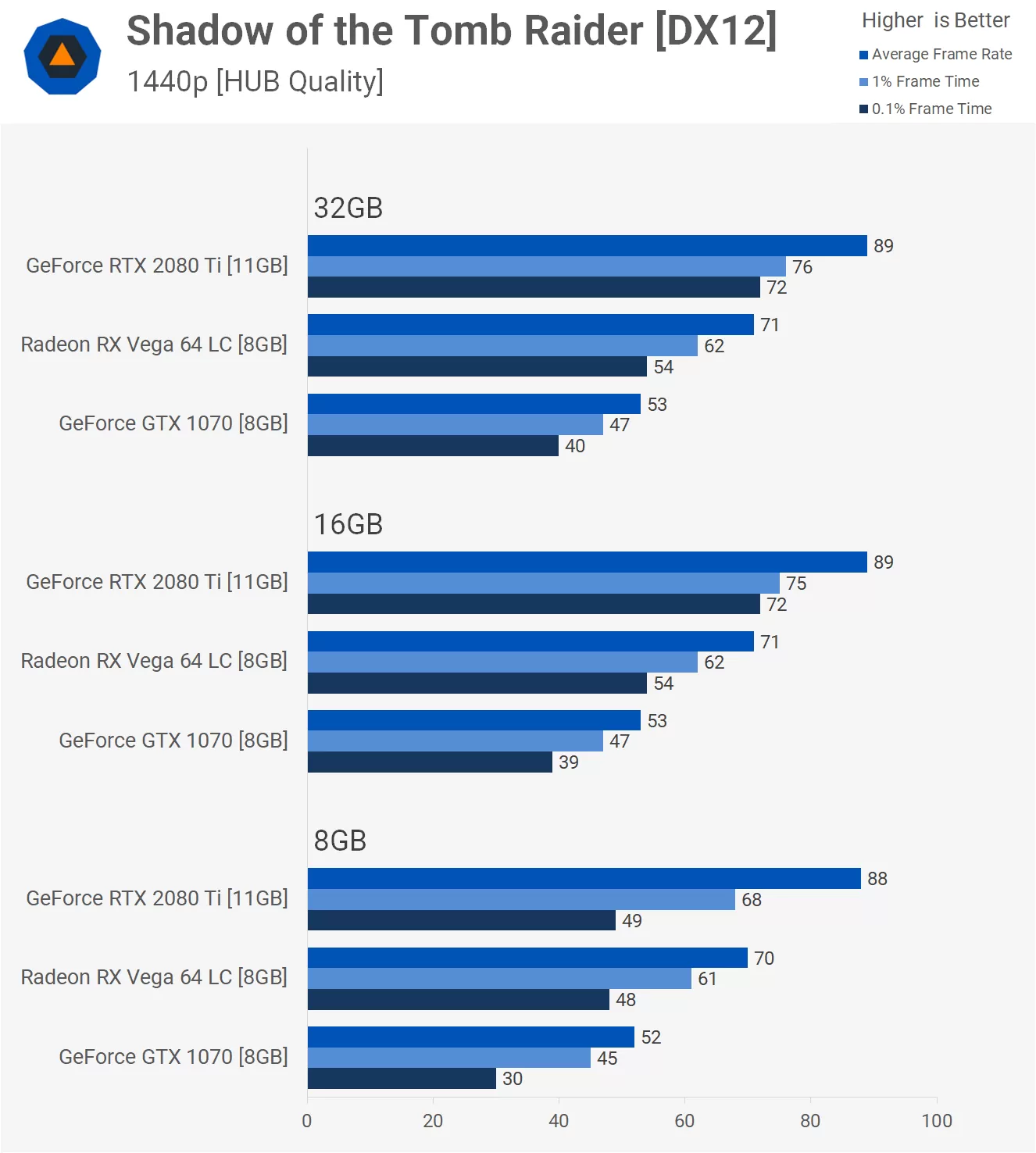
Shadow of the Tomb Raider showed united states that with the RTX 2080 Ti results using either 16 or 32GB or RAM were much the same. Even so, with only 8GB the performance hit was massive, though you wouldn't know information technology solely past looking at the average frame rate. The hit to frame time performance was substantial and at times the stuttering in-game was very noticeable. Hither nosotros saw up to a 32% driblet for the 0.i% low result.
Every bit before, the hitting for Vega 64 isn't as extreme where we saw an 11% performance reduction, while the hit to the GTX 1070 was as much as 23%.
Benchmarks Part ii
Previously we found that lower-end graphics cards featuring less VRAM tend to suffer the most when running with limited system memory. So I went back and re-tested with the Radeon RX 580 8GB, RX 570 4GB and GTX 1060 3GB at 1080p and 1440p.

Battlefield V shows petty to no difference between sixteen and 32GB as expected. Yet, with 8GB we see a noticeable performance hit to the RX 570 and GTX 1060, then much so that even the average frame rates dipped. We saw this in last year'southward test. The 3GB GTX 1060 struggles with frame time performance in modernistic titles when using less than 16GB of system retentiveness.

Naturally the state of affairs isn't improved at 1440p, though it'south actually interesting just how much the RX 570 suffers with 8GB of RAM in this title. The striking for the 3GB GTX 1060 is pretty significant too, but damn does the Radeon GPU become hit hard. Basically you lot don't want to be playing Battleground 5 multiplayer with just 8GB of RAM, specially if y'all have a lower-cease GPU with 4GB or less VRAM.


For titles such equally Hitman 2 the performance hit is basically non-real. We're not seeing much exterior of the margin of error here.
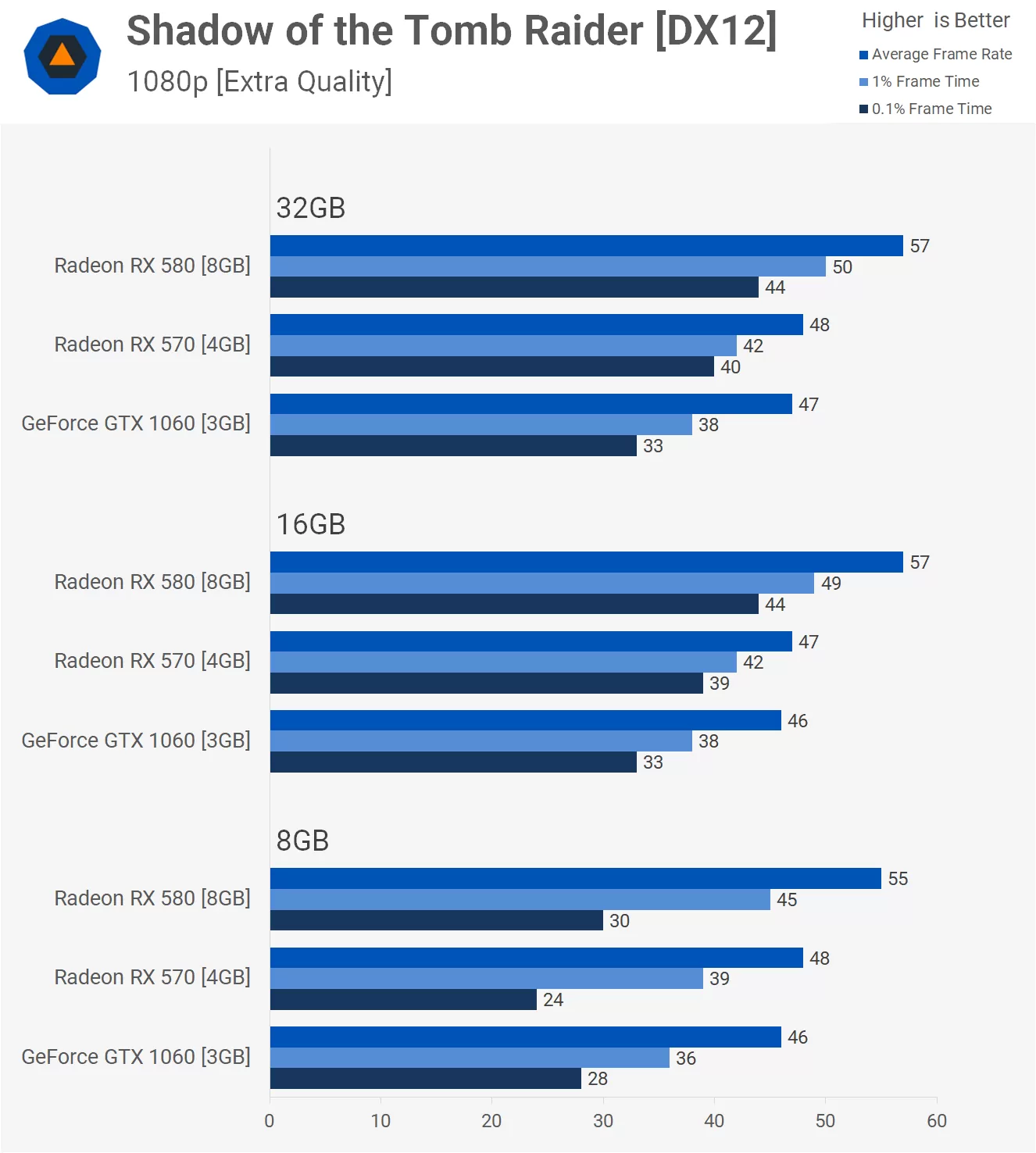
Equally seen previously with loftier-terminate GPUs, Shadow of the Tomb Raider runs into issues when using only 8GB of RAM and we're seeing that here with all mid-range graphics cards nosotros tested. The hit to frame fourth dimension performance, in item the 0.1% lows, was extreme for all three configurations.

Naturally this was too seen at 1440p and here the 3GB GTX 1060 tanked with frequent and noticeable stuttering. The 1440p resolution too proved to be a bit much for the RX 570.
Wrap Up
If you desire to play the latest and greatest, the most demanding titles, yous desire 16GB of RAM. This time last year we found that 8GB was the minimum and today that'south truer than always.
Of course, if you play less demanding titles such every bit Fortnite, Overwatch and Rocket League, for example, or old but yet very popular titles such as DOTA ii and CSGO, then 8GB of organization retentivity will exist plenty. Merely if you want to become amongst it in Battlefield V or enjoy the breathtaking visuals of Shadow of the Tomb Raider without the constant reminder that your system isn't quite upwardly to par, then nosotros recommend at least 16GB.

For mid-range to lower-stop rigs where small-scale stuttering can be acquired past bereft VRAM, ho-hum storage, or not having enough CPU cores, existence on the edge of the optimal memory chapters probably isn't going to make much departure. For example, a Cadre i3-8350K system with a bones TLC SSD and a graphics card with a ii-3GB VRAM capacity, you're going to see some stuttering in titles such every bit Battlefield V. And then while upgrading from 8GB to 16GB of RAM will assist, it's not going to completely solve stuttering issues.
Alternatively, those rocking new high-cease hardware similar the flagship RTX 2080 Ti... all this talk about memory capacity is kind of redundant anyhow, but become 32GB and forget about it. If you're spending over $1000 on a graphics card, are you honestly going to think twice virtually spending $400 of DDR4 memory? Probably not.
For near of you, 16GB is going to be the sweet spot and this is what we recommend. For today's latest games 8GB is out, 16GB is the sweetness spot and 32GB remains overkill.
Shopping Shortcuts:
- 8GB DDR4 RAM: Corsair, Thousand.Skill, Kingston, Patriot
- 16GB DDR4 RAM: Corsair, K.Skill, Kingston, Patriot
- 32GB DDR4 RAM: Corsair, One thousand.Skill, Crucial, Ballistix
- Radeon RX 570 on Amazon, Newegg
- Radeon RX 580 on Amazon, Newegg
- GeForce GTX 1060 6GB on Amazon
- GeForce GTX 1070 Ti on Amazon, Newegg
- GeForce RTX 2070 on Amazon, Newegg
- GeForce RTX 2080 on Amazon, Newegg
- GeForce RTX 2080 Ti on Amazon, Newegg

Source: https://www.techspot.com/article/1770-how-much-ram-pc-gaming/
Posted by: zenoliat1992.blogspot.com
0 Response to "How Much RAM Do Gamers Need? 8GB vs. 16GB vs. 32GB"
Post a Comment